AI in Healthcare Is Entering a New Era
For the past few years, much of the conversation around artificial intelligence in healthcare has centered on AI scribes - tools that listen during patient visits and automatically generate clinical notes.
These solutions have delivered meaningful value by reducing documentation burden and giving clinicians more time to focus on patients.
But healthcare organizations are beginning to realize something important:
Clinical documentation is only one part of the care journey.
The real opportunity lies in improving the entire workflow surrounding patient care.
Healthcare is entering a new era - one where AI doesn't simply document work, but actively helps coordinate it.
The Next Step Beyond Documentation
A typical outpatient visit involves far more than writing notes.
Before, during, and after every appointment, clinics manage dozens of operational tasks:
- Patient intake and registration
- Appointment scheduling
- Insurance and billing preparation
- Room and resource allocation
- Clinical documentation
- Follow-up communication
- Care coordination
Each step creates opportunities for delays, manual work, and communication gaps.
If AI only assists with documentation, many of these inefficiencies remain unchanged.
The next generation of healthcare AI focuses on supporting the entire clinical workflow, enabling teams to work together more efficiently while improving the patient experience.
From AI Scribes to Intelligent Healthcare Agents
The healthcare industry is increasingly shifting from single-purpose AI tools toward intelligent AI agents capable of supporting multiple operational tasks.
Instead of performing one isolated function, AI agents can assist with different stages of the patient journey while working together as part of a connected platform.
Examples include:
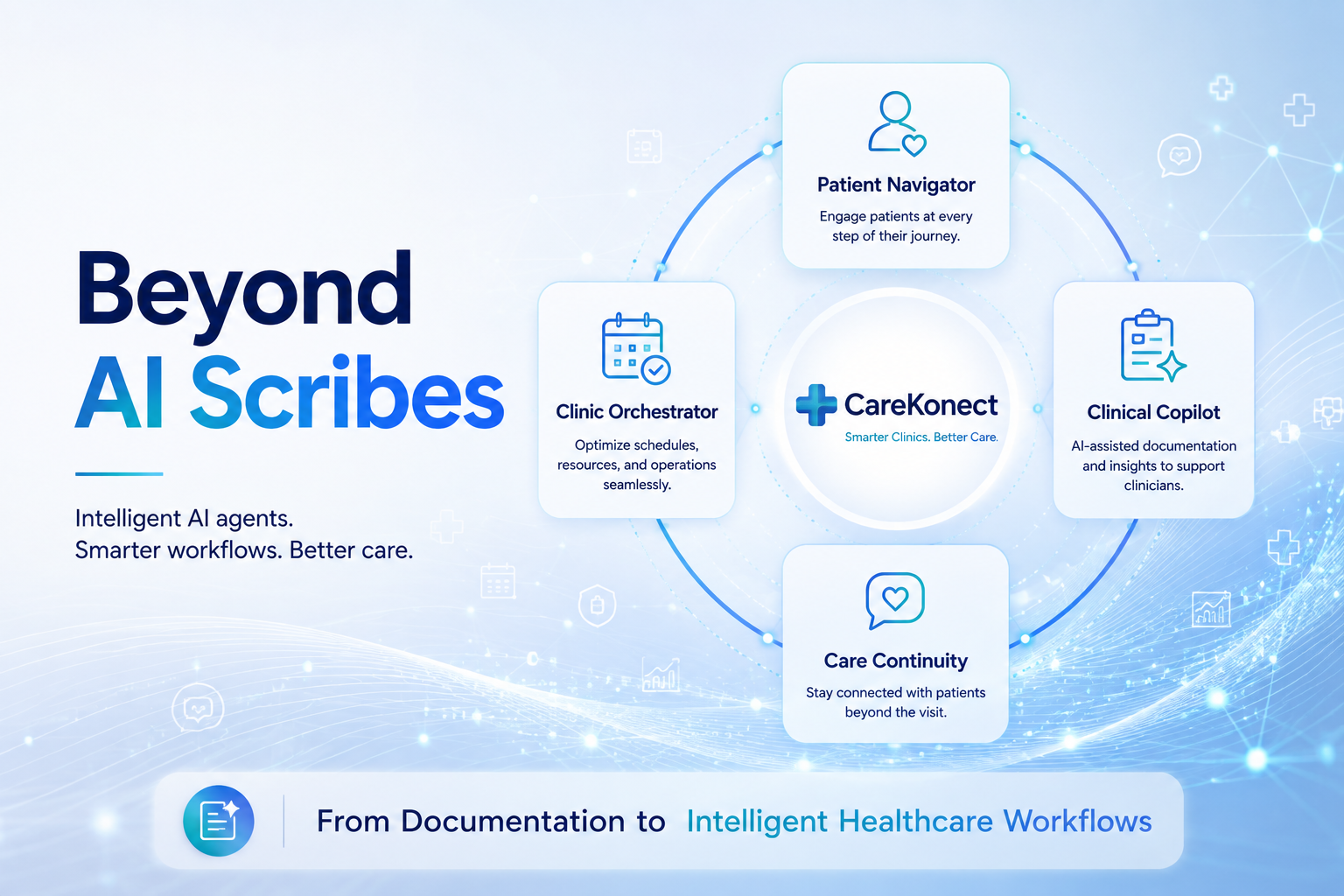
Patient Navigator
Helping patients complete digital intake, guiding them through appointments, and improving engagement before they arrive at the clinic.
Clinic Orchestrator
Coordinating schedules, providers, examination rooms, and operational resources to improve efficiency throughout the day.
Clinical Copilot
Supporting clinicians with AI-assisted documentation, visit summaries, and workflow intelligence while allowing healthcare professionals to remain in control of clinical decisions.
Care Continuity
Extending patient engagement beyond the visit through follow-up reminders, educational resources, and ongoing communication.
Together, these capabilities transform AI from a documentation assistant into a collaborative partner across the entire care journey.
Why Workflow Matters
Many operational challenges in healthcare are not caused by a lack of clinical expertise.
They are caused by fragmented workflows.
Patients wait longer than expected.
Providers spend valuable time searching for information.
Staff manually coordinate appointments and follow-ups.
Communication often occurs across disconnected systems.
Improving workflow helps every member of the care team - not just physicians.
By reducing administrative complexity, healthcare organizations can improve:
- Patient satisfaction
- Operational efficiency
- Staff productivity
- Care coordination
- Resource utilization
The result is a better experience for both patients and healthcare professionals.
Building Connected Healthcare Instead of Isolated Tools
Healthcare organizations are increasingly looking beyond standalone AI applications.
Rather than adding another disconnected solution, many are searching for platforms that integrate multiple intelligent capabilities into a unified experience.
Connected platforms can support:
- Intelligent patient intake
- Clinical workflow automation
- Appointment orchestration
- AI-assisted documentation
- Operational visibility
- Continuous patient engagement
When these capabilities work together, clinics gain more than automation - they gain coordination.
The Future Is Collaborative AI
The future of healthcare AI is unlikely to be defined by a single model or a single application.
Instead, it will be shaped by intelligent systems that collaborate with healthcare teams, support operational decisions, and improve experiences throughout the patient journey.
AI should not replace clinicians.
It should remove unnecessary administrative work, surface meaningful information at the right time, and help care teams focus on what matters most: delivering high-quality patient care.
As healthcare continues to evolve, the greatest opportunity is no longer simply documenting visits.
It is enabling connected, intelligent, and coordinated healthcare operations.
How CareKonect Approaches Intelligent Clinic Operations
At CareKonect, we believe AI should support the entire healthcare ecosystem - not just one task.
Our platform is designed around intelligent capabilities that work together to streamline clinic operations and strengthen patient experiences:
- Patient Navigator: guiding patients from intake through ongoing engagement.
- Clinic Orchestrator: coordinating appointments, resources, and operational workflows.
- Clinical Copilot: assisting clinicians with documentation and workflow intelligence.
- Care Continuity: supporting follow-up communication and long-term patient connections.
Rather than replacing existing clinical systems, our goal is to help healthcare teams work more efficiently by connecting workflows across the patient journey.
Looking Ahead
The conversation around healthcare AI is rapidly evolving.
As organizations move beyond AI scribes and begin exploring intelligent workflow platforms, the focus is shifting from documentation to coordination, from isolated tools to connected ecosystems.
The clinics that embrace this broader view of AI will be better positioned to improve operational efficiency, strengthen patient engagement, and deliver more connected care in the years ahead.
Explore More
Interested in learning how intelligent workflow platforms can support your clinic?
Book a personalized demo to see how CareKonect is helping healthcare organizations build smarter, more connected operations.